

How to Choose the Right HARTING Connector for Your Project?
Your project is on a tight deadline. A connector fails due to corrosion. Now, you face costly downtime and delays1. This is a common and frustrating problem for many managers.
The best HARTING connector is not just about a part number. It is about matching the right material to your environment and partnering with a supplier who understands your timeline. This choice prevents future failures and delivery delays.
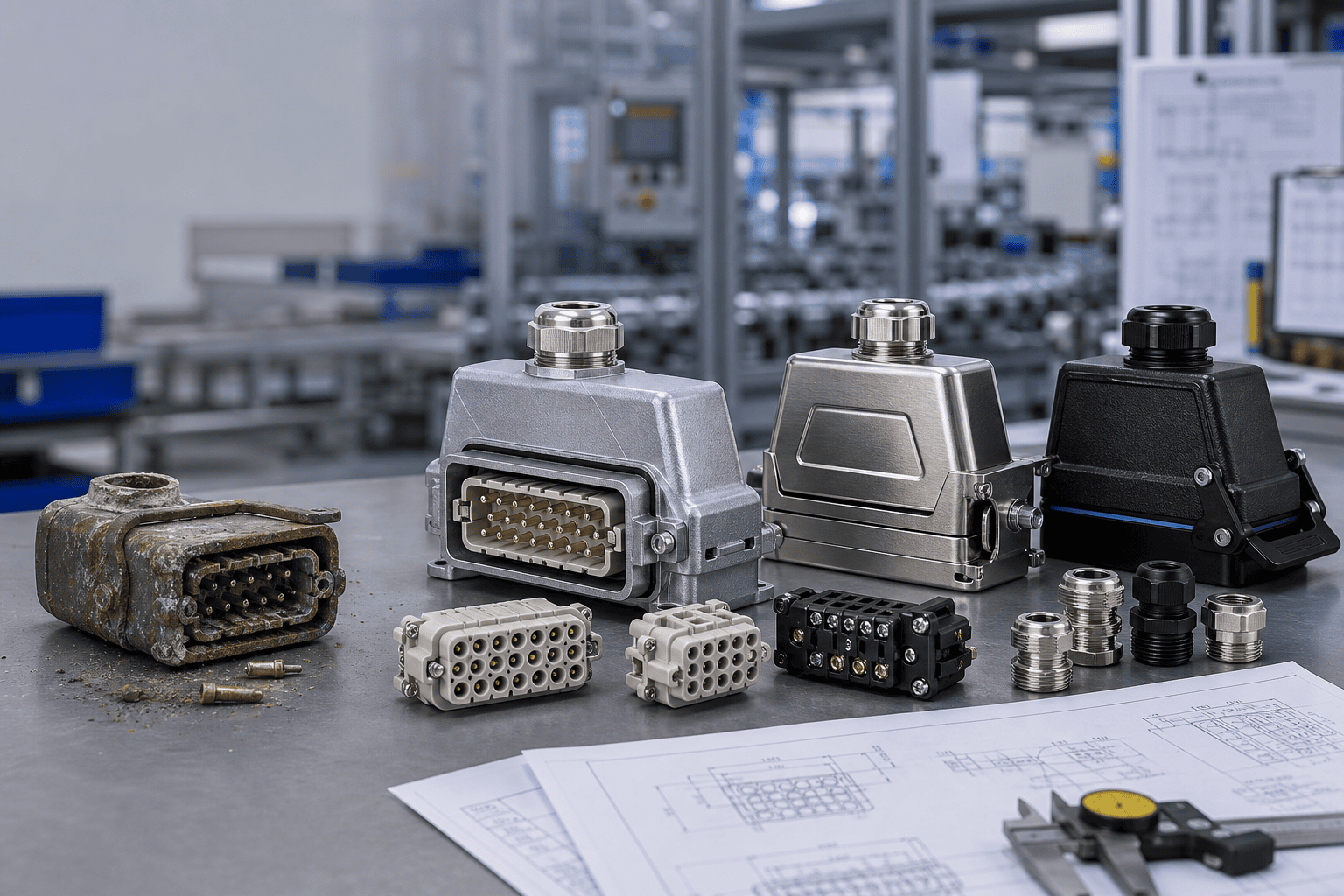
I've been in this business for over ten years. I see customers wrestling with the same critical questions every day. They want to avoid making a costly mistake. So, let's break down the two most common questions I hear. This will help you make a better decision for your next project.
Do they manufacture lightweight or corrosion-resistant alternatives?
You need a connector for a specific environment. Maybe it's a high-vibration machine or a saltwater-exposed panel. Choosing the wrong material can lead to premature failure and costly repairs.
Yes, HARTING offers many alternatives. They have lightweight aluminum housings and highly durable stainless steel options2 for corrosion resistance. But the "best" choice is not simple. It always involves a trade-off between performance, cost, and availability.
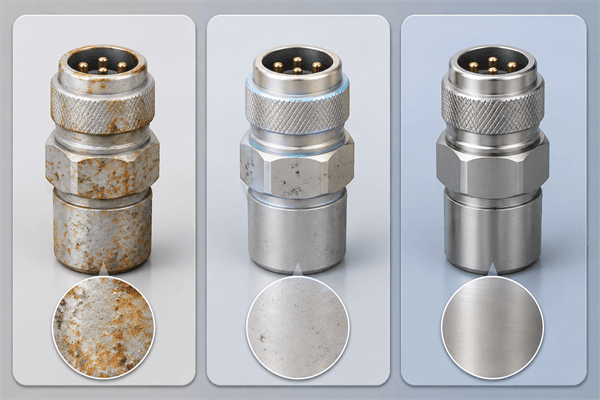
When a client asks me for a "corrosion-resistant" part, my first question is always, "Tell me about the environment." A connector on a marine vessel faces different challenges than one in a food processing plant.3 The single word "corrosion" doesn't tell the whole story. Focusing only on one feature, like "lightweight," can lead you to choose a connector that can't handle the vibrations on your factory floor. It's about finding the right balance for your specific job.
Understanding the Material Trade-Off
You must balance multiple factors. There is no single "best" material for all jobs. I remember a client who was building automation for a coastal facility. They initially wanted the lightest connector to save on shipping costs. I had to explain that the constant salt spray would destroy a standard aluminum connector in just a few months4. We switched to a more suitable material with a protective coating. This decision saved them from a massive recall and repair job down the line. It's this kind of practical experience that makes a difference.
Here’s a simple breakdown of common choices to help you think through the options:
| Material | Key Benefit | Main Drawback | Best For |
|---|---|---|---|
| Aluminum Die-Cast | Standard, Cost-Effective | Lower Corrosion Resistance5 | General factory automation, control cabinets |
| Thermoplastic | Lightweight, Good Value | Lower Mechanical Strength6 | Applications where weight is critical, less harsh |
| Stainless Steel | Highest Corrosion/Chemical Resistance | Higher Cost, Heavier | Marine, food & beverage, chemical plants7 |
| Coated Aluminum | Improved Corrosion Resistance8 | Higher cost than standard | Outdoor applications, transportation |
As you can see, the decision is a strategic one. It's about managing your project's risk, not just checking a box on a technical data sheet.
What is the lead time, and is the part available from stock?
Your production line is ready. Your team is waiting. But the critical connectors you ordered are stuck on backorder for weeks. This is a supply chain nightmare for any manager.
Directly from the factory, HARTING lead times can often be 10 to 18 weeks, and some models are restricted9. However, a specialized stocking partner like us can provide immediate availability for many of these same parts, solving your urgent needs.
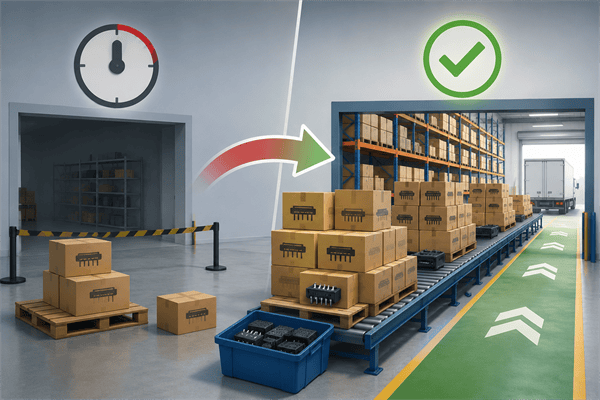
This is the question that keeps project managers up at night. I hear the frustration in their voices all the time. "My project is delayed because I can't get this one small part." The truth is, lead time and stock availability are not fixed properties of a part. They are reflections of your sourcing strategy. Waiting 10, 14, or even 18 weeks for a part from the original manufacturer is a huge problem. I've seen too many projects stall because of it.
The Manufacturer Channel vs. The Stocking Partner
Relying solely on the manufacturer's standard ordering process works for planned, long-term projects. But it creates huge risks for urgent needs, maintenance and repair, or when a part becomes hard to find. We've built our business to solve this exact problem. For example, we work with major automotive clients like Changan Auto. They cannot afford a line-down situation10. We analyze their needs and maintain dedicated stock of their critical Harting connectors. This means they get their parts in days, not months. This proactive stocking strategy is our core advantage.
Here’s how the two sourcing approaches compare:
| Sourcing Factor | Manufacturer Direct Channel | Specialist Stocking Partner (SX-Electronics) |
|---|---|---|
| Lead Time | 10-18+ weeks | Typically 1-3 days from our stock |
| MOQ | Often high11 | Flexible, low MOQ supported |
| Hard-to-Find Parts | Limited support, often discontinued | Our specialty, we find them |
| Flexibility | Low, fixed processes | High, responsive to urgent needs |
So, instead of just asking "Is it in stock?", a better question for your supplier is, "How can you help me build a reliable supply for my project's timeline?" This shifts the focus from a single transaction to a long-term, reliable partnership.
Conclusion
Choosing the right HARTING connector means matching the material to your application and the supplier to your timeline. This dual focus ensures both performance and project success.
"[PDF] Corrosion Failure in Electronic Devices for Aerospace Application", https://ntrs.nasa.gov/api/citations/20180003089/downloads/20180003089.pdf. A report from an industrial consulting or research firm can provide data on the average cost of unplanned downtime per hour in various industries, supporting the claim that such events are costly. The source may not specifically isolate connector corrosion as the cause but will substantiate the high cost of component failure in general. Evidence role: statistic; source type: research. Supports: The source should provide statistics or analysis on the financial costs of unplanned downtime in manufacturing or industrial environments.. ↩
"[PDF] HARTING Selection Guide Han-Modular® Connectors", https://b2b.harting.com/files/livebooks/en/PRD0200000100250/downloads/livebook.pdf. The manufacturer's official product catalog or technical documentation confirms the availability of connector series with housings made from various materials, including die-cast aluminum and stainless steel (e.g., the Han M or Han INOX series). Evidence role: general_support; source type: other. Supports: The source should be official documentation from the manufacturer, HARTING, that lists the various material options available for their connector housings.. Scope note: The source is from the manufacturer being discussed and serves to verify product features rather than provide third-party analysis. ↩
"Selecting and Purchasing Food Process Equipment", https://extension.okstate.edu/fact-sheets/selecting-and-purchasing-food-process-equipment. An engineering standards body, such as NEMA, or a materials science guide can detail the different environmental conditions and corrosive agents found in marine settings (e.g., chloride-induced corrosion from salt spray) versus food processing plants (e.g., corrosion from acidic foods and caustic cleaning agents). Evidence role: mechanism; source type: institution. Supports: The source should describe the different environmental standards and corrosive agents present in marine versus food processing applications.. ↩
"[PDF] Corrosion of Bare and Coated Al 5052-H3 and Al 6061-T6 in Seawater", https://www.hnei.hawaii.edu/wp-content/uploads/Corrosion-of-Aluminum-Alloys-in-Seawater.pdf. Technical papers or materials engineering handbooks detailing results from standardized salt spray tests (e.g., ASTM B117) show that unprotected aluminum alloys exhibit significant pitting and corrosion within hundreds of hours of exposure, supporting the claim of rapid failure in a constant salt spray environment. Evidence role: statistic; source type: paper. Supports: The source should provide data on the corrosion rate of standard aluminum alloys when exposed to saline environments.. ↩
"Galvanic series - Wikipedia", https://en.wikipedia.org/wiki/Galvanic_series. A materials science or engineering resource can explain that aluminum is more anodically active than materials like stainless steel, as shown in the galvanic series. This makes it more susceptible to galvanic corrosion when in contact with more noble metals in the presence of an electrolyte, thus having relatively lower corrosion resistance. Evidence role: mechanism; source type: education. Supports: The source should explain the electrochemical properties of aluminum that make it susceptible to corrosion.. ↩
"Aluminum vs. Thermoplastic Materials for Custom Extrusions", https://www.omegaplastics.com/aluminum-vs-thermoplastic-which-material-is-better-for-your-application/. A materials database or engineering textbook can provide comparative data showing that while engineering thermoplastics (e.g., polycarbonate) are durable, their tensile and flexural strength are typically lower than those of metallic alloys like die-cast aluminum. Evidence role: statistic; source type: research. Supports: The source should provide a quantitative comparison of mechanical properties between engineering thermoplastics and metals like aluminum.. ↩
"Packaging & Food Contact Substances (FCS) - FDA", https://www.fda.gov/food/food-ingredients-packaging/packaging-food-contact-substances-fcs. Regulatory bodies and industry standards organizations often specify the use of stainless steel in these applications. For example, the FDA's food code requires food-contact surfaces to be corrosion-resistant, and certain grades of stainless steel are commonly used to meet this requirement in food, beverage, and chemical processing. Evidence role: expert_consensus; source type: government. Supports: The source should be a standard or regulation for one of the listed industries that specifies material choices.. ↩
"Low Temperature Sealing of Anodized Aluminum Alloy for ... - PMC", https://pmc.ncbi.nlm.nih.gov/articles/PMC7662489/. A technical article on materials science or surface finishing can explain that coatings like powder coats or anodized layers create a non-reactive barrier. This barrier isolates the aluminum substrate from atmospheric oxygen and moisture, preventing the electrochemical reactions that cause corrosion. Evidence role: mechanism; source type: paper. Supports: The source should explain the physical or chemical process by which coatings protect aluminum from corrosion.. ↩
"Back to the Future: Electronic Component Allocation", https://www.componentsense.com/blog/electronic-component-allocation-component-sense-back-to-the-future-series?srsltid=AfmBOorwJq9rBa9wznydgHd7PAeHmlHiwMQe_Gzqq9pL-tKb0-kjum1l. A supply chain industry resource can explain the practice of 'allocation,' where manufacturers limit the distribution of in-demand or supply-constrained components to manage shortages. This practice can result in certain parts becoming 'restricted' or unavailable through standard purchasing channels. Evidence role: definition; source type: institution. Supports: The source should define the concept of component allocation or other sales restrictions in the electronics industry.. ↩
"Cost of Automotive Line Downtime - Arch Systems", https://archsys.io/hub/articles/the-22000-per-minute-cost-of-automotive-line-downtime-how-ai-predicts-and-prevents-equipment-failures/. Studies and reports on automotive manufacturing frequently quantify the cost of a 'line-down' or unplanned production stoppage. These sources indicate that even a brief halt in an assembly line can cost tens of thousands of dollars per minute, underscoring the critical importance of supply chain reliability. Evidence role: statistic; source type: research. Supports: The source should provide data on the financial cost of production stoppages in the automotive industry.. ↩
"[PDF] Raw Material Minimum Order Quantity Optimization - DSpace@MIT", https://dspace.mit.edu/bitstream/handle/1721.1/121302/1240293813-MIT.pdf?sequence=1. A business or supply chain management resource can explain that manufacturers use Minimum Order Quantities (MOQs) to cover the fixed costs of production runs, such as machine setup and administrative overhead. This economic necessity often results in high MOQs for direct orders, as opposed to distributors who buy in bulk and sell smaller quantities. Evidence role: mechanism; source type: education. Supports: The source should explain the economic rationale behind manufacturers setting Minimum Order Quantities (MOQs).. ↩